Supreme Court Dismisses PIL Seeking Nationwide Ban on Pornography What the Order Really Means
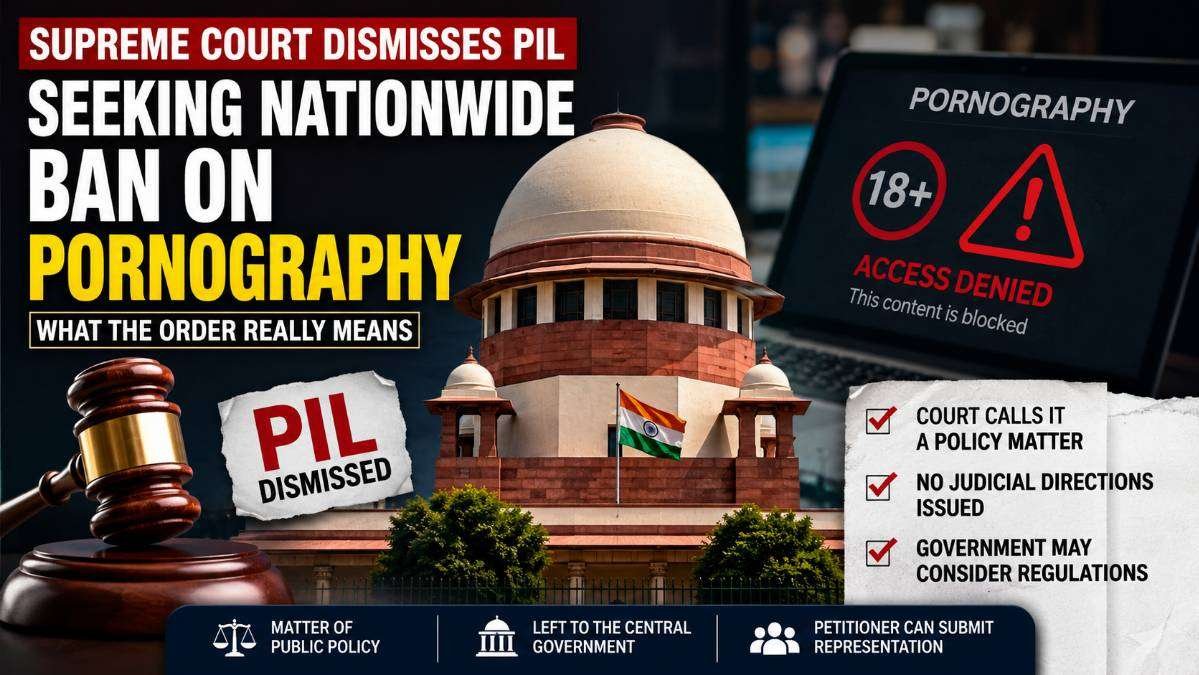
The Supreme Court of India recently dismissed a Public Interest Litigation (PIL) that sought directions for a nationwide ban on viewing pornographic content in India.
Soon after the order was passed, several social media posts claimed that the Supreme Court had ruled “No Ban on Porn” or had legalized pornography. These claims quickly spread across social media platforms, leading to confusion among the public.
However, a closer look at the court proceedings and official information shows that these viral claims do not present the complete picture. The Supreme Court did not declare pornography legal, nor did it prohibit the government from introducing stricter regulations in the future.
Instead, the Court observed that the matter primarily falls within the domain of public policy, which is the responsibility of the executive and the legislature.
What Was the PIL About?
The Public Interest Litigation was filed by petitioner B.L. Jain before the Supreme Court of India. The petition requested the Court to direct the Central Government to formulate a comprehensive national policy aimed at restricting the viewing of pornographic content across the country.
The petitioner argued that unrestricted access to such content negatively affects children, teenagers, families, and society. The PIL also highlighted concerns about the availability of explicit content on the internet, particularly its accessibility to minors.
It urged the government to strengthen technological safeguards, improve internet regulation, and create awareness regarding responsible digital usage.
READ THIS: Delhi High Court on Permanent Alimony Financial Need Matters
What Did the Supreme Court Decide?
A Bench headed by Chief Justice Surya Kant, along with Justice Joymalya Bagchi and Justice V. Mohana, heard the matter. After considering the petition, the Supreme Court dismissed the PIL.
While dismissing the case, the Court observed that the issue raised by the petitioner involves policy decisions rather than judicial intervention. It noted that framing regulations for online content requires detailed consideration of constitutional rights, technological challenges, administrative mechanisms, and legislative policy.
The Court therefore declined to issue any mandatory directions to the Union Government. At the same time, it permitted the petitioner to submit a detailed representation before the appropriate authorities so that the government could examine the issues raised.
Why Did the Court Refuse to Intervene?
The Supreme Court has consistently maintained that courts should not step into areas that are primarily reserved for policymakers unless there is a clear violation of constitutional or legal rights.
In this matter, the judges felt that regulating online content across India requires expert consultation, technological infrastructure, public policy decisions, and legislative action. Such matters are generally handled by Parliament and the Central Government rather than through judicial orders.
The Court’s decision therefore reflects the constitutional principle of separation of powers, where each branch of government performs its designated role.
Does the Order Mean Pornography Is Legal?
No. This is perhaps the biggest misunderstanding arising from the viral social media posts.
The Supreme Court’s dismissal of the PIL does not mean that pornography has been legalized in India. The Court did not issue any declaration stating that pornography cannot be regulated or banned. It merely chose not to entertain the PIL because it considered the matter to be a policy issue.
Therefore, describing the order as a “No Ban” judgment is misleading and does not accurately reflect what the Court actually decided.
READ THIS: Karnataka High Court on School Bus Safety Schools Responsible for Children Until Safe Drop
Current Legal Position in India
India already has several laws governing obscene and sexually explicit content.
The Information Technology Act, 2000 contains provisions dealing with the publication and transmission of obscene material in electronic form. The Protection of Children from Sexual Offences (POCSO) Act and other relevant laws strictly prohibit child sexual abuse material and impose severe penalties for producing, distributing, or possessing such content.
Over the years, the Central Government has also directed internet service providers to block access to hundreds of websites containing prohibited content under applicable legal provisions.
Therefore, India’s legal framework already regulates various forms of online obscene content, particularly where children are involved or where criminal offences are committed.
Can the Government Introduce New Regulations?
Yes. The Supreme Court’s order does not prevent the Union Government from introducing additional regulations in the future.
If the government considers it necessary, it may formulate new rules, strengthen existing laws, introduce technological safeguards, or propose legislation through Parliament after consulting experts and stakeholders.
The Court simply stated that such decisions should originate from the appropriate policymaking authorities rather than through judicial directions.
Why Did the News Become Misleading?
Social media often simplifies complex legal decisions into short headlines. In this case, phrases such as “No Ban on Porn” spread rapidly because they attracted attention.
However, legal orders usually contain detailed reasoning that cannot be accurately summarized in just a few words. Without reading the actual order or reliable reports, many users assumed that the Supreme Court had endorsed unrestricted access to pornography, which is not what the judgment says.
Legal experts have also pointed out that dismissing a PIL does not necessarily amount to agreeing or disagreeing with the subject matter. It only means that the Court found the petition unsuitable for judicial intervention in its present form.
READ THIS: BIS-Certified Helmet Rules in India 2026 Official MoRTH & BIS Guidelines
Importance of Reading Official Sources
This incident once again demonstrates why relying solely on viral social media graphics can lead to misinformation.
Official court orders, government notifications, and reports from credible news organizations provide the necessary context required to understand judicial decisions accurately.
Before sharing legal news online, readers should verify the facts through official judicial records or trusted publications instead of depending only on social media posts.
Conclusion
The Supreme Court of India did not rule that pornography cannot be banned, nor did it legalize pornographic content. The Court simply dismissed a Public Interest Litigation seeking judicial directions because it considered the issue to be a matter of public policy that falls within the responsibility of the Central Government and Parliament.
The existing legal provisions regulating obscene content and protecting children remain fully applicable. The Union Government is free to examine the petitioner’s concerns and, if considered necessary, introduce new policies or legislative measures in the future.
Therefore, the viral claim stating that the Supreme Court declared a permanent “No Ban on Porn” is misleading. The actual order emphasizes constitutional boundaries between the judiciary and the executive while leaving future policy decisions to the appropriate authorities.
About The Author