Mobile recharge prices have once again become a topic of discussion among Indian telecom users. Reports about a possible increase in prepaid tariffs for Reliance Jio, Airtel and Vodafone Idea (Vi) are circulating widely, with some claims suggesting that recharge prices could rise by around 12 to 15 percent.
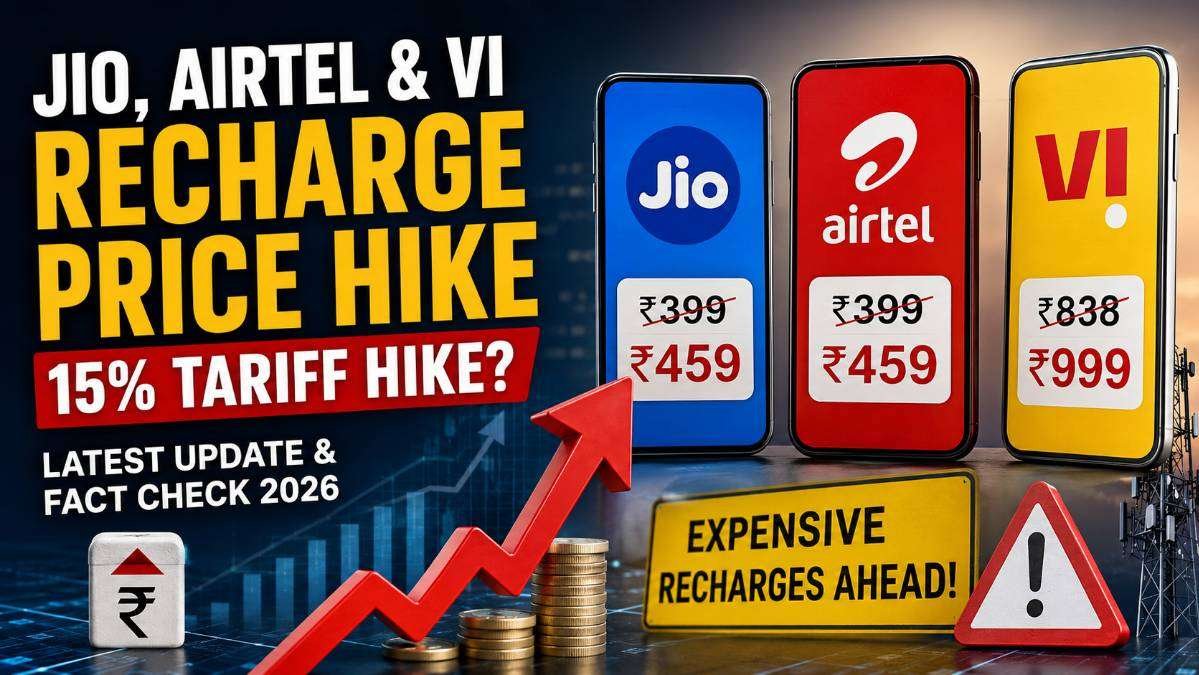
At the same time, several social media posts are sharing specific prices and claiming that budget recharge plans below Rs. 200 will be removed completely. Some graphics even show examples such as a Rs. 399 plan becoming Rs. 459 and a Rs. 838 plan becoming Rs. 999.
However, there is an important difference between an expected tariff increase and an officially announced tariff revision. As of August 10, 2026, the telecom companies have not officially confirmed the exact 15 percent nationwide price increase shown in these viral graphics.
Why Are Another Mobile Tariff Hike Reports Circulating?
The possibility of another tariff increase has been discussed by telecom analysts and industry observers for several months. Telecom operators have been trying to improve their average revenue per user while continuing to invest heavily in 5G networks, spectrum, network expansion and other infrastructure.
Analyst reports have suggested that Indian telecom companies could consider another increase in mobile tariffs. Some recent reports have put the possible increase in the range of approximately 12 to 15 percent over the coming months.
It is important to understand that such estimates come from analysts and industry research. They are not equivalent to a tariff announcement made by Jio, Airtel or Vi.
READ THIS: UPI Charges for Large Merchants Has the Government Introduced MDR? Latest Official Update
Have Jio, Airtel and Vi Officially Announced a 15 Percent Hike?
No. There is currently no official announcement from all three operators confirming that their prepaid tariffs will increase by exactly 15 percent nationwide.
This distinction is important because telecom companies normally publish revised tariff information when a new pricing structure is introduced. A report predicting a possible price increase cannot be treated as confirmation that every existing recharge plan will become 15 percent more expensive.
Therefore, users should be careful before forwarding social media graphics that describe the proposed increase as an already confirmed tariff revision.
What Does the Viral Rs. 399 to Rs. 459 Claim Mean?
One of the most widely shared claims shows an existing Rs. 399 recharge becoming Rs. 459 after a 15 percent increase.
The calculation itself is approximately correct. A 15 percent increase on Rs. 399 comes to around Rs. 458.85, which can be rounded to Rs. 459.
But the mathematical calculation does not mean that a telecom operator has officially selected Rs. 459 as the new price.
The same principle applies to other prices shown in viral graphics. A person can calculate a possible future price by applying a percentage increase, but the actual price selected by an operator could be different.
The Rs. 838 to Rs. 999 Claim Needs More Attention
There is another issue with the viral graphic. It presents Rs. 838 as an old price and Rs. 999 as a new price while describing the overall change as a 15 percent tariff hike.
However, Rs. 838 to Rs. 999 represents an increase of roughly 19 percent, not 15 percent.
This does not prove that a tariff hike will not happen. Instead, it shows why the exact prices in the graphic should not be treated as an official price list.
Will All Recharge Plans Below Rs. 200 Be Removed?
Another major claim being circulated is that Jio, Airtel and Vi will remove all budget prepaid plans priced below Rs. 200.
There is no official confirmation supporting such a blanket statement from all three operators.
In fact, Airtel’s published prepaid terms continue to contain a Rs. 199 price point. This demonstrates why the statement that every recharge below Rs. 200 is being removed should not be presented as a confirmed nationwide policy.
Individual plans can certainly be modified, withdrawn or replaced. Operators can also change the availability of particular plans in different circles. But that is different from saying that every recharge below Rs. 200 will disappear across India.
Airtel Has Made Changes to Some Recharge Plans
There have been reports of Airtel changing or withdrawing certain prepaid plans. Such changes have attracted attention because users often interpret the removal of a low-cost plan as the beginning of a larger tariff revision.
However, a change to individual recharge plans does not automatically mean that Airtel has announced a nationwide 15 percent increase across its entire prepaid portfolio.
Airtel’s official prepaid terms continue to list multiple price points, including Rs. 199, Rs. 219, Rs. 299, Rs. 319, Rs. 349, Rs. 399, Rs. 579, Rs. 619, Rs. 838 and several higher-value plans.
The availability of a particular recharge can depend on the operator’s current tariff structure, circle, customer category and the channel through which the recharge is made. Users should therefore check the official Airtel application or website before making a recharge based on information circulating on social media.
What About Reliance Jio?
Reliance Jio remains one of India’s largest telecom operators, and any change to its prepaid pricing would have a significant impact on millions of subscribers.
Jio has continued to offer a range of prepaid plans covering different validity periods, data allowances and calling requirements. However, an exact nationwide 15 percent tariff increase with the specific prices shown in viral posts has not been officially announced.
Users should therefore distinguish between analyst predictions about a future tariff revision and actual prices displayed by Jio through its official recharge channels.
What About Vodafone Idea (Vi)?
Vi is also under pressure to improve its financial performance and average revenue per user while continuing investments in its network.
Vi’s 2025-26 annual report discusses the importance of tariff adjustments and improving industry economics. This provides evidence that tariff increases remain an important issue for the telecom industry.
However, discussion about the need for better tariffs is not the same as an official announcement stating that every Vi prepaid plan will increase by 15 percent.
READ THIS: Google Selfie Video Account Recovery New Security Feature
Why Do Telecom Companies Want Higher Tariffs?
There are several reasons why telecom operators may seek higher tariffs.
1. Network Expansion
Building and maintaining mobile networks requires significant investment. Operators are continuing to expand 4G and 5G coverage while upgrading network infrastructure.
2. Spectrum Costs
Spectrum is a major expense for telecom companies. Operators need sufficient spectrum resources to provide reliable mobile services and increase network capacity.
3. Increasing Data Consumption
Indian consumers are using more mobile data than before. Video streaming, social media, online education, gaming, digital payments and cloud-based services have increased the demand for mobile connectivity.
4. Improving Average Revenue Per User
Telecom companies closely monitor average revenue per user, commonly known as ARPU. Higher ARPU can help operators generate more revenue from their existing subscriber base and support future investments.
What Should Mobile Users Do Now?
There is no need for users to panic or immediately recharge based only on a viral social media post.
If your current plan is still active, continue using it normally. Before purchasing a long-validity plan, check the latest price and benefits directly through the operator’s official application or website.
Users should also compare the actual benefits of a plan instead of looking only at its price. Validity, daily data allowance, unlimited calling, SMS benefits, 5G eligibility and additional services can all affect the real value of a recharge.
Should You Recharge in Advance?
Some users may consider purchasing a long-validity plan before a possible tariff increase. This can make financial sense if the operator officially announces a price revision and the plan’s terms allow the user to queue or extend future validity through additional recharges.
However, there is no reason to buy several recharges simply because an unverified graphic is circulating online.
The better approach is to wait for an official announcement and then compare the old and new prices before making a decision.
TRAI’s Role in Telecom Tariffs
The Telecom Regulatory Authority of India, or TRAI, oversees and regulates several aspects of India’s telecommunications sector. TRAI publishes tariff-related regulations, directions, consultations and other documents concerning telecom services.
TRAI’s official records should therefore be considered when checking major claims about telecom tariffs and consumer-related rules. However, individual mobile tariff decisions are primarily made by telecom operators within the applicable regulatory framework.
READ THIS: Does Airplane Mode Charge Your Phone Faster? Official Google & Apple Battery Charging Guide
Final Verdict on the Viral 15 Percent Recharge Hike Claim
The claim that Jio, Airtel and Vi are preparing to increase prepaid recharge prices deserves attention, because industry analysts have indeed discussed the possibility of another tariff increase. A hike in the broad range of 12 to 15 percent has been projected in recent industry reports.
But the viral graphic goes further by presenting specific future prices and claiming that all budget plans below Rs. 200 will be removed. Those specific claims have not been officially confirmed by all three telecom operators.
The Rs. 399 to Rs. 459 example appears to be a mathematical projection based on a 15 percent increase rather than an officially announced price. The Rs. 838 to Rs. 999 example also does not represent a 15 percent increase, making the graphic even less reliable as an official price chart.
Conclusion
Indian mobile users may have to prepare for another round of telecom tariff increases, but it is too early to treat every viral recharge-price graphic as official information. Jio, Airtel and Vi may revise their tariffs in the future, and analysts have projected increases in the range of around 12 to 15 percent. Nevertheless, the exact percentage, effective date and new prices will depend on the decisions made by the individual telecom operators.
For now, the most accurate conclusion is that a future tariff hike is a possibility supported by industry expectations, while the specific prices shown in viral posts remain unconfirmed. Consumers should rely on official Jio, Airtel and Vi recharge pages and verified company announcements before changing their recharge strategy.
In short, “15 percent recharge hike confirmed” is not an accurate headline at this stage. A more accurate description would be: “Jio, Airtel and Vi may increase mobile tariffs, but the exact hike and new recharge prices have not been officially confirmed.”
About The Author