Why Is There a 9 SIM Card Limit in India? Official DoT Rule Explained & How to Check SIMs Linked to Aadhaar
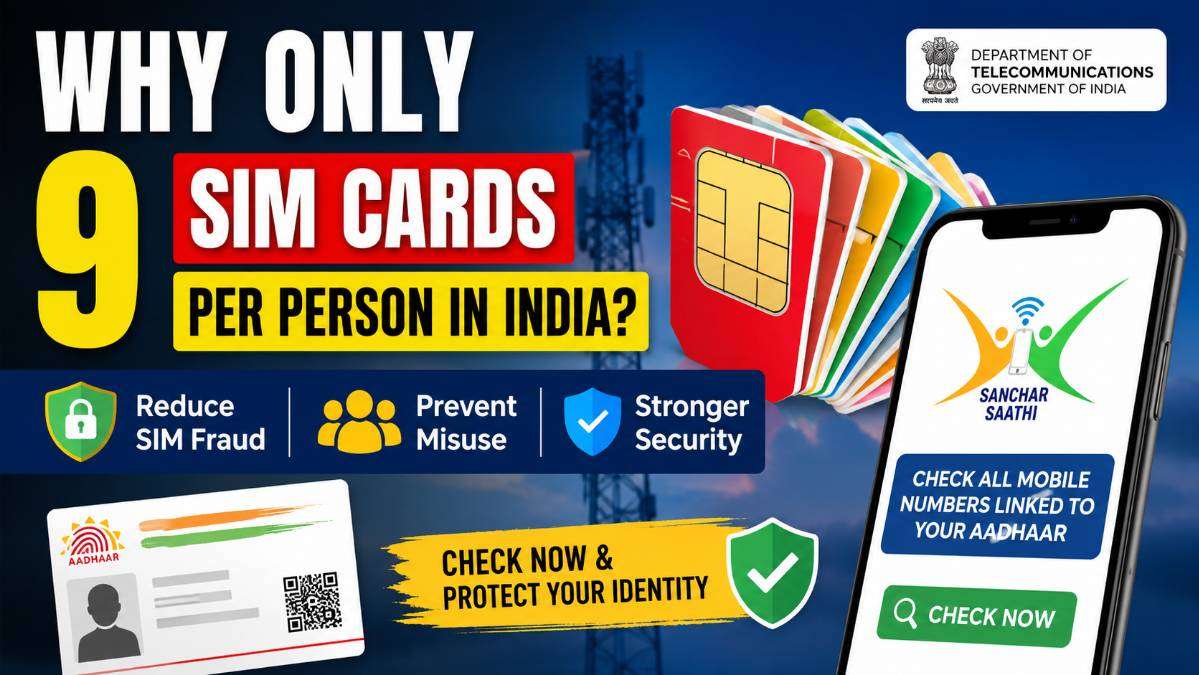
Mobile phones have become an essential part of everyday life. From banking and UPI payments to online education, government services, and social media, almost everything is linked to a mobile number.
As digital services continue to grow, mobile numbers have become valuable digital identities. Unfortunately, this has also led to an increase in cyber fraud, fake SIM cards, identity theft, and online scams.
Many people are now asking an important question: How many SIM cards can one person legally own in India? Another common doubt is why the limit is set at nine SIM connections instead of ten or any other number.
In this article, we explain the official rules, the reason behind the limit, and how you can check all the mobile numbers issued in your name.
What Is the Official SIM Card Limit in India?
According to the Department of Telecommunications (DoT), Government of India, an individual subscriber can hold a maximum of nine active mobile connections across all telecom operators combined. This limit applies regardless of whether the SIM cards belong to Airtel, Jio, BSNL, or Vodafone Idea.
However, there is an exception. In the licensed service areas of Jammu & Kashmir, Assam, and the North Eastern states, the maximum limit is six active mobile connections.
This rule is implemented by the Department of Telecommunications to improve subscriber verification and strengthen the country’s telecom security framework.
READ THIS: PAN Card Signature After Update 2026: Minor or Major? Who Should Sign & What To Do
Why Is the Limit Set at Nine SIM Cards?
This is one of the most searched questions online. Interestingly, the Government of India has not officially published any document explaining why the exact number chosen is nine instead of ten or any other figure.
In other words, there is no official policy document that explains the specific reason for selecting the number nine.
However, the objective behind introducing a maximum limit is clear. The policy helps authorities reduce the misuse of mobile connections and makes it easier to identify suspicious activities.
Why Was This Rule Introduced?
- To reduce fake SIM card registrations.
- To prevent identity theft using forged Aadhaar or fake documents.
- To control spam calls and fraudulent SMS campaigns.
- To strengthen Know Your Customer (KYC) verification.
- To help law enforcement agencies investigate cybercrime more efficiently.
- To prevent criminals from obtaining dozens of SIM cards under a single identity.
Therefore, while the exact number nine has not been officially justified, the purpose of limiting mobile connections is to improve security and reduce telecom fraud.
Can You Buy a New SIM Every Month?
Yes. Many people regularly change telecom operators to take advantage of better offers, improved network coverage, or personal preferences.
The important point is that the rule applies only to the number of active mobile connections registered in your name at the same time.
For example, if you stop using an old SIM and properly deactivate it before purchasing a new one, there is no issue. Similarly, if you port your existing mobile number to another telecom operator using Mobile Number Portability (MNP), it is still considered the same connection and does not increase your total SIM count.
Problems arise only when multiple unused SIM cards remain active under your identity.
Why Should You Check SIM Cards Registered in Your Name?
Cyber fraud has increased significantly in recent years. Criminals sometimes obtain SIM cards using forged documents or misuse someone else’s identity during registration.
If an unknown SIM card is issued in your name, it could potentially be used for fraudulent activities without your knowledge.
That is why the Department of Telecommunications encourages subscribers to periodically verify all active mobile connections linked to their identity.
READ THIS: How Blockchain and Cryptocurrency Work Simple & Clear Explanation
How to Check Mobile Numbers Registered in Your Name
You can verify your active mobile connections through the Government of India’s official Sanchar Saathi portal.
- Visit the official Sanchar Saathi portal.
- Open the Telecom User section.
- Enter your mobile number.
- Complete OTP verification.
- View all active mobile connections registered under your identity.
If you notice a number that does not belong to you, you can report it directly through the portal for further verification and action.
Official Link to Check SIM Cards
Sanchar Saathi Portal:
https://tafcop.sancharsaathi.gov.in/telecomUser/
What Should You Do If You Find an Unknown SIM?
If you discover an unfamiliar mobile number linked to your identity, do not ignore it. Report the number through the Sanchar Saathi portal. Contact the concerned telecom operator immediately. Request verification or disconnection if the SIM does not belong to you. Keep checking your registered mobile connections regularly.
Common Myths About the 9 SIM Rule
Myth: The government scientifically proved that nine is the safest number.
Fact: No official document states why exactly nine was selected.
Myth: Buying a new SIM every month is illegal.
Fact: Purchasing a new SIM is completely legal as long as your total active connections remain within the prescribed limit.
Myth: The rule applies separately to every telecom company.
Fact: The limit applies to the total number of active mobile connections across all telecom operators combined.
Conclusion
The nine-SIM limit is an important telecom security measure introduced by the Department of Telecommunications to reduce fraud and improve accountability. Although the government has not officially explained why the number is specifically nine, the overall objective is to strengthen subscriber verification and prevent misuse of mobile connections.
Considering the rise in cybercrime and fake SIM fraud, every mobile user should periodically verify all active connections registered in their name using the official Sanchar Saathi portal. A simple check can help protect your identity and prevent unauthorized misuse of your personal information.
Disclaimer: This article is based on the current guidelines published by the Department of Telecommunications (DoT), Government of India. Rules may change in the future. Always refer to the official Sanchar Saathi website for the latest information.
Frequently Asked Questions (FAQs)
1. How many SIM cards can one person have in India?
According to the Department of Telecommunications (DoT), an individual can have a maximum of 9 active mobile connections across all telecom operators in India. In Jammu & Kashmir, Assam, and North Eastern Licensed Service Areas, the limit is 6 active connections.
2. Why is the SIM card limit set at 9 instead of 10?
The Government of India has not officially explained why the number is specifically nine. However, the limit is intended to reduce fake SIM registrations, strengthen KYC verification, and prevent cyber fraud and misuse of mobile connections.
3. Can I buy a new SIM card every month?
Yes. You can purchase a new SIM whenever required. The rule only limits the total number of active SIM cards registered in your name at one time.
4. Does Mobile Number Portability (MNP) increase my SIM count?
No. When you port your existing mobile number to another telecom operator, it remains the same connection and does not increase your total active SIM count.
5. How can I check how many mobile numbers are registered in my name?
You can visit the official Sanchar Saathi (TAFCOP) portal, verify your mobile number using OTP, and view all active mobile connections registered under your identity.
6. Is Aadhaar required to check SIM cards linked to my identity?
No. You only need access to your registered mobile number for OTP verification. Aadhaar details are not required during the checking process.
7. What should I do if I find an unknown SIM card registered in my name?
You should immediately report the number through the Sanchar Saathi portal and contact the concerned telecom operator to request verification or disconnection.
8. Is there any fee for checking SIM cards linked to my identity?
No. The Sanchar Saathi portal is an official Government of India service and can be used free of cost.
9. Does the 9 SIM limit apply separately to each telecom company?
No. The limit applies to the combined total of all active mobile connections across every telecom operator, including Airtel, Jio, BSNL, and Vodafone Idea.
10. Why should I regularly check SIM cards registered in my name?
Regularly checking your active mobile connections helps detect unauthorized SIM cards, protects your identity, and reduces the risk of cyber fraud and financial scams.
About The Author