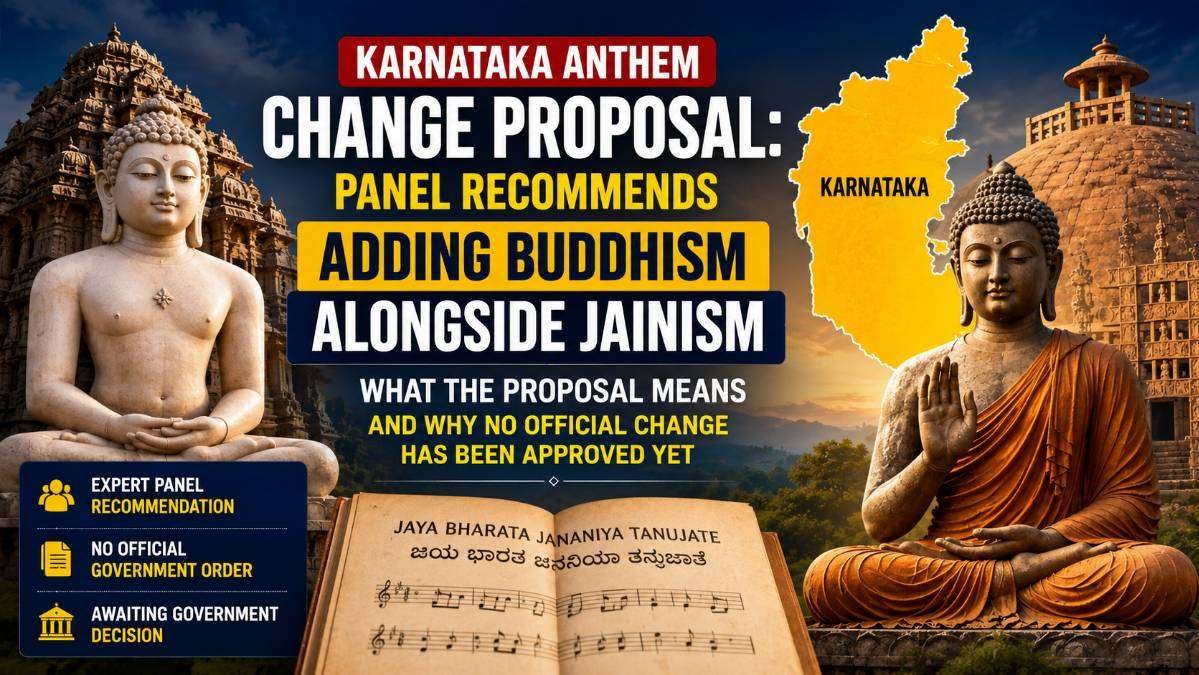
A recent proposal concerning Karnataka’s state anthem has sparked discussions across the state. Several media reports have stated that an expert committee has recommended mentioning the rise of Buddhism alongside Jainism in the lyrics of Karnataka official anthem, “Jaya Bharata Jananiya Tanujate”, written by the renowned Kannada poet Kuvempu.
While the recommendation has attracted public attention and political debate, it is important to understand that the proposal has not yet become official government policy.
Social media posts have rapidly circulated the news, leading many people to believe that the Karnataka government has already approved the change. However, official information available at the time of writing indicates that the suggestion is still at the recommendation stage. No government notification or gazette order has been issued confirming that the anthem’s lyrics have been amended.
READ THIS: Dr. B.R. Ambedkar Resignation and the Hindu Code Bill Official Facts
What Is Karnataka’s State Anthem?
“Jaya Bharata Jananiya Tanujate” is the official state anthem of Karnataka. Penned by Rashtrakavi Kuvempu, the song celebrates the cultural heritage, history, language, and unity of Karnataka. For decades, it has been sung during government functions, educational institutions, and official ceremonies across the state.
The anthem holds deep emotional and cultural significance for Kannadigas. Because of its importance, any discussion regarding changes to its lyrics naturally attracts widespread public interest and careful scrutiny.
What Does the Proposal Say?
According to multiple media reports, an expert panel reviewing aspects of Karnataka’s cultural and historical representation has proposed adding a reference to the rise of Buddhism alongside Jainism in the anthem.
The recommendation aims to acknowledge the historical contribution of Buddhism to Karnataka’s cultural development while continuing to recognize the importance of Jainism.
The proposal reflects the historical reality that both Buddhism and Jainism influenced different regions of Karnataka at various periods. Archaeological discoveries, inscriptions, monuments, and historical literature indicate that Buddhist traditions existed in parts of Karnataka, although Jainism maintained a stronger and longer-lasting presence in many areas.
Has the Government Approved the Change?
As of now, the answer is no.
While reports confirm that the expert committee has made a recommendation, there is currently no official notification issued by the Government of Karnataka confirming any amendment to the state anthem. A proposal submitted by a committee does not automatically become government policy.
Before any official modification to a state symbol such as the anthem is implemented, the recommendation would typically need to be reviewed by the appropriate government departments. If approved, the government would issue an official order or gazette notification informing the public about the decision.
Until such an official announcement is made, the existing officially recognized version of Karnataka’s anthem remains unchanged.
READ THIS: INDmoney Launches Free Income Tax Filing for AY 2026-27 Everything Investors Need to Know
Why Is This Proposal Receiving Attention?
The discussion has generated considerable attention because state symbols carry immense cultural value. Even minor suggestions involving an anthem, flag, emblem, or official song often become subjects of public debate.
Supporters of the recommendation argue that acknowledging Buddhism alongside Jainism provides a broader recognition of Karnataka’s diverse historical traditions. They believe that the state’s history includes contributions from multiple religious and philosophical movements that shaped its culture.
Others believe that a widely respected literary work should remain exactly as originally written by its author. For them, preserving Kuvempu’s original composition is an important way of protecting Karnataka’s literary heritage.
These differing opinions reflect the importance people attach to cultural identity and historical representation rather than indicating that any official change has already taken place.
Understanding the Difference Between a Proposal and an Official Decision
One of the biggest reasons for confusion has been the rapid spread of social media graphics and short posts. Many users have shared headlines without explaining that the recommendation has not yet been accepted by the government.
A proposal simply means that an advisory body or committee has suggested an idea for consideration. It does not carry legal authority by itself. Only after the government formally accepts the recommendation and publishes an official order does it become an implemented decision.
Therefore, readers should avoid assuming that the anthem has already been revised based solely on social media posts or unofficial graphics.
READ THIS: Karnataka High Court on School Bus Safety Schools Responsible for Children Until Safe Drop
Importance of Relying on Official Sources
Whenever news relates to government policies, constitutional matters, educational reforms, or official state symbols, citizens should verify information using trusted sources.
Government websites, gazette notifications, official preFeatured image illustrating the Karnataka anthem change proposal with Jain and Buddha statues, Karnataka state map, and the state anthem, highlighting an expert panel’s recommendation to mention Buddhism alongside Jainism. No official government approval has been issued.ss releases, and verified statements from concerned departments provide the most reliable confirmation of policy decisions.
Media reports play an important role in informing the public about ongoing developments, but recommendations discussed in news reports should not be mistaken for officially approved government actions unless confirmed through formal government communication.
What Happens Next?
The future of the proposal depends entirely on the Government of Karnataka. Authorities may choose to accept the recommendation, modify it, seek further consultation, or decide not to implement it. Until an official decision is announced, the proposal remains under consideration.
Citizens, educators, historians, and cultural organizations may continue to discuss the recommendation as part of the democratic process. Such discussions often help governments understand public opinion before making decisions on culturally significant matters.
Conclusion
The recent discussion regarding Karnataka’s state anthem has generated widespread interest because it concerns one of the state’s most respected cultural symbols.
At present, the available information indicates that an expert panel has only proposed mentioning Buddhism alongside Jainism in the anthem. The recommendation has not yet been officially approved by the Government of Karnataka, and no government notification or gazette order confirms any change to the anthem’s lyrics.
Readers should therefore distinguish between a committee’s recommendation and an official government decision. Until the state government issues formal confirmation, Karnataka’s officially recognized anthem remains unchanged.
Staying informed through official government announcements rather than relying solely on social media helps ensure that public understanding remains accurate and based on verified information.
About The Author