Rahul Gandhi Detained During Student Protest in New Delhi What Happened and Key Facts
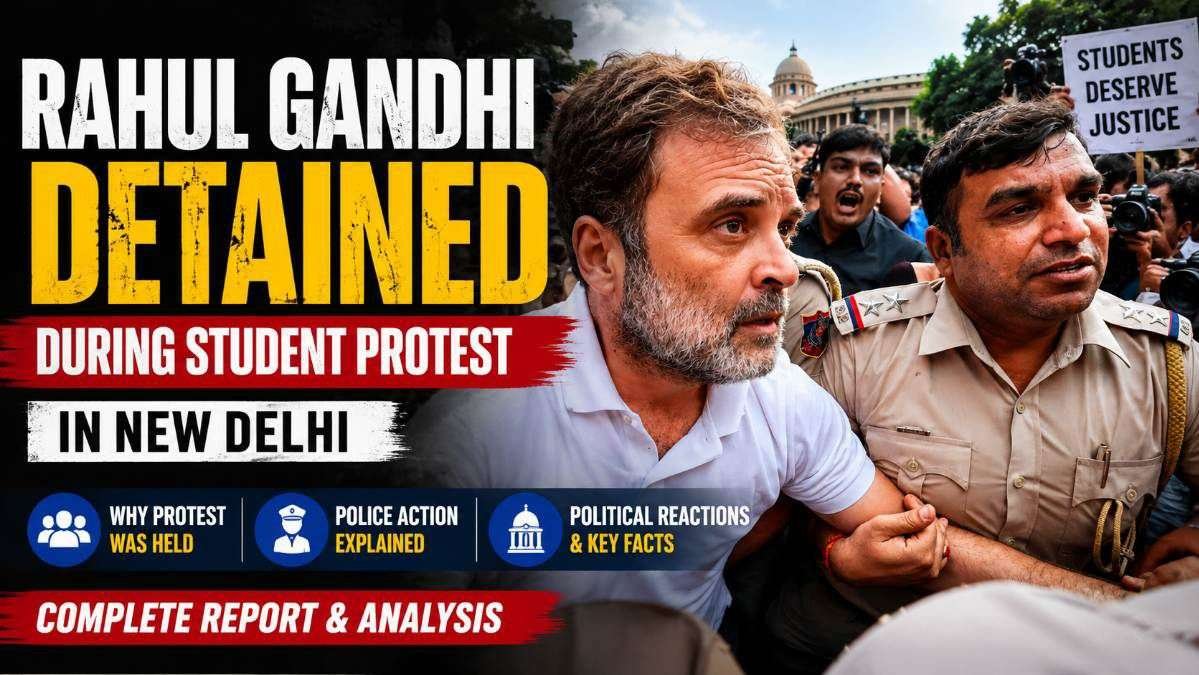
Congress leader Rahul Gandhi was detained by Delhi Police during a protest march in New Delhi on 21 July 2026, drawing nationwide attention and sparking a fresh political debate over the rights of students and democratic protests.
The incident occurred when Rahul Gandhi, along with senior Congress leaders and party workers, attempted to march towards the Prime Minister’s residence to express solidarity with students demanding justice over recent examination-related issues.
Images and videos from the protest quickly spread across social media, showing Rahul Gandhi being escorted by police officers while surrounded by supporters and media personnel.
The incident soon became one of the most discussed political developments of the day, with both the ruling party and the opposition presenting their own versions of the events.
Why Was the Protest Organised?
The Congress party organised the protest to voice support for students who have been demanding accountability and fairness regarding examination-related concerns. According to Congress leaders, the protest was intended to highlight the need for transparency and justice for students affected by recent controversies.
Rahul Gandhi and other opposition leaders argued that students deserve to have their concerns heard and that peaceful demonstrations are an important part of a democratic society. The party announced a march towards the Prime Minister’s residence to submit its message directly to the government.
What Happened During the March?
The protest began peacefully with Congress leaders, Members of Parliament, and party workers gathering in New Delhi. As the procession moved towards the high-security area near the Prime Minister’s residence, Delhi Police stopped the march.
Police officers informed the protesters that they could not proceed further because of security restrictions in the area. After the protesters continued their demonstration, police detained several leaders, including Rahul Gandhi.
Photographs and video footage released by various news organisations show police officers escorting Rahul Gandhi away from the protest site. Several Congress leaders were also taken into preventive custody before being released later.
Rahul Gandhi’s Message
Before and during the protest, Rahul Gandhi shared a strong message supporting students. In his social media post, he stated:
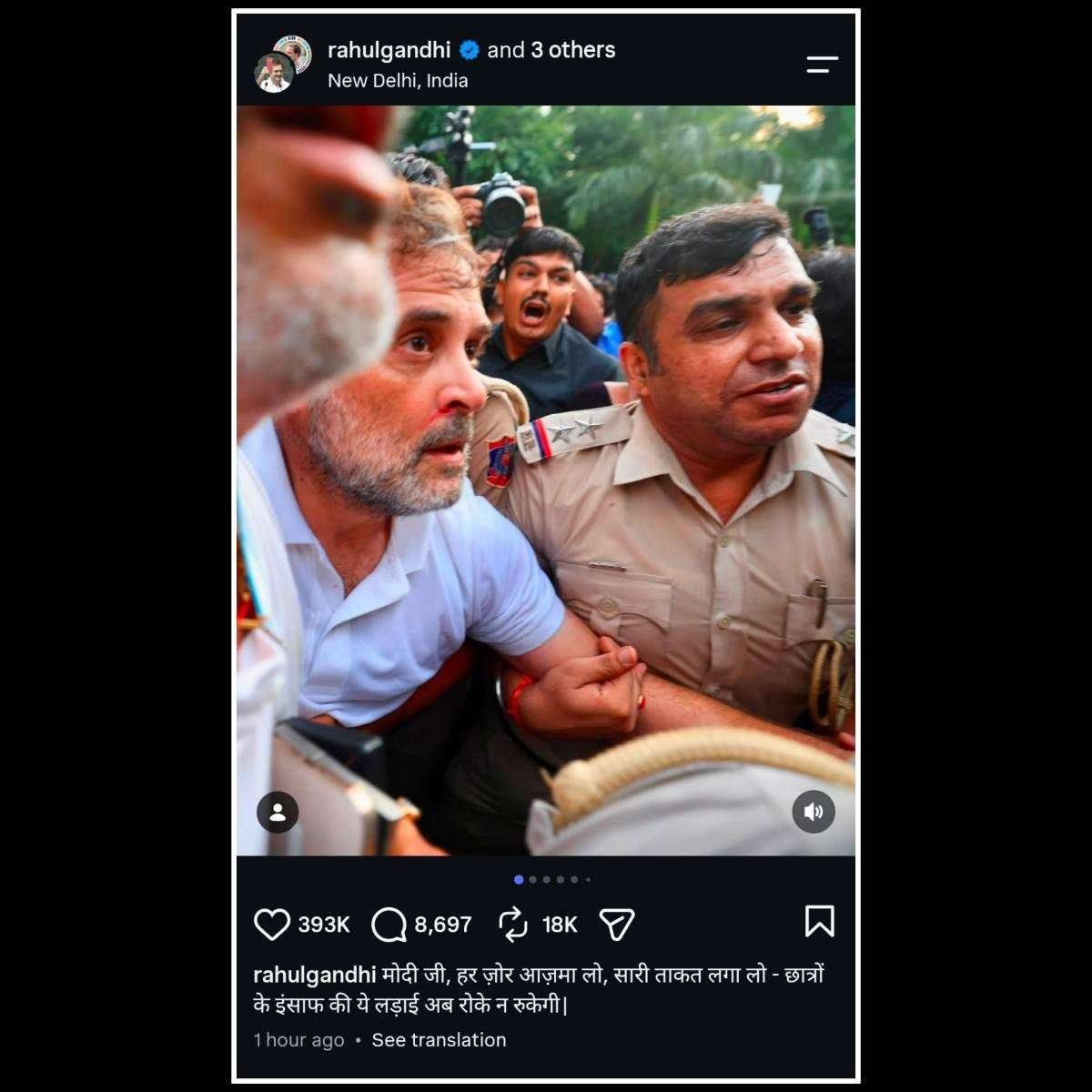
“Modi Ji, use all your strength if you want, but this fight for justice for students cannot be stopped.”
The statement reflected the Congress party’s political position that student voices should not be suppressed and that democratic protests should be respected.
Delhi Police’s Action
Delhi Police stated that the march was stopped because it was moving towards a highly secured area around the Prime Minister’s residence. Security arrangements in this zone are among the strictest in the country, and unauthorised demonstrations are generally not permitted close to the Prime Minister’s official residence.
Police detained the protesters under preventive measures to maintain law and order and avoid any security risks. Officials maintained that the action was taken according to established security protocols.
Congress Responds
Congress leaders criticised the police action, claiming that the protest was peaceful and that the detention of opposition leaders was unnecessary. The party alleged that democratic rights were being restricted and accused the government of attempting to silence voices raising issues concerning students.
Several senior Congress leaders demanded that citizens should be allowed to peacefully express their concerns without facing detention.
Government’s Position
The government and security authorities defended the police action, stating that security around the Prime Minister’s residence cannot be compromised. Officials explained that the restrictions were not aimed at any particular political party but were part of standard security procedures applicable to everyone.
The government also maintained that while peaceful protests are permitted in designated areas, marches towards sensitive government installations are regulated for security reasons.
Political Reactions
The incident generated strong political reactions across the country. Opposition parties largely supported Rahul Gandhi and criticised the police action, while leaders from the ruling alliance argued that security rules must be respected regardless of political affiliation.
The protest also triggered widespread discussions on social media, where supporters and critics expressed differing opinions about both the protest and the police response.
Public Discussion
The detention once again brought attention to two important issues in Indian democracy: the right to peaceful protest and the responsibility of authorities to ensure public security. Many citizens debated whether political demonstrations near sensitive government locations should be allowed, while others focused on the concerns raised by students that led to the protest.
Legal experts noted that preventive detention during protests is not uncommon when demonstrations move towards restricted areas. At the same time, they emphasised that peaceful protest remains a constitutional right, subject to reasonable restrictions for public safety.
Verified Facts
- Rahul Gandhi participated in a Congress-led protest in New Delhi.
- The protest was organised in support of students seeking justice over examination-related issues.
- Delhi Police stopped the march near the Prime Minister’s residence because of security restrictions.
- Rahul Gandhi and several Congress leaders were detained during the protest.
- Videos and photographs of the detention were widely reported by national and international media.
- The caption shared on Rahul Gandhi’s social media account reflects his political opinion and message supporting the protest.
Conclusion
The detention of Rahul Gandhi during the New Delhi protest has become one of the major political developments of the day. While the Congress party views the incident as an attempt to suppress democratic protest, the authorities maintain that their actions were necessary to protect a highly sensitive security zone.
Regardless of political viewpoints, the incident has renewed discussions about democratic rights, public demonstrations, student concerns, and the balance between freedom of expression and national security.
As the political debate continues, the focus is expected to remain on both the issues raised by protesting students and the broader questions surrounding the right to peaceful protest in India.
About The Author