India has taken action against battery management applications linked to reports of e-rickshaws being remotely disabled through Bluetooth connections.
The development has attracted public attention after several videos circulated on social media showing people apparently stopping electric rickshaws using mobile phones.
The viral videos initially looked like prank content to many viewers. However, the issue soon raised serious questions about the security of Bluetooth-enabled battery management systems used in some electric vehicles.
The matter became more concerning because an unauthorised person could potentially connect to a compatible battery management system and interfere with certain battery functions.
According to reports, the government intervened after the issue was brought to the attention of the Ministry of Electronics and Information Technology.
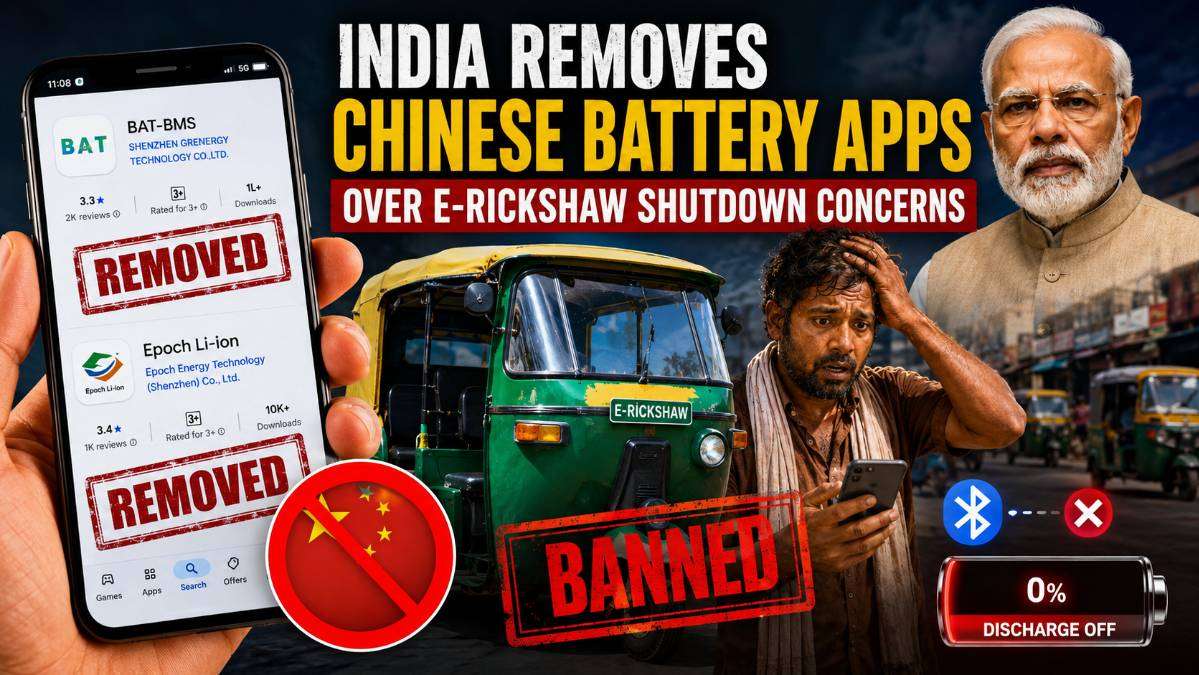
Apps associated with the battery management systems were subsequently removed from app stores. BAT-BMS and Epoch Li-ion were among the applications widely mentioned in connection with the controversy.
The action has started a wider discussion about cybersecurity, connected vehicle technology and the need for stronger security standards in India’s rapidly growing electric mobility sector.
What Happened With the E-Rickshaw Battery Apps?
The controversy began after videos showing e-rickshaws being stopped through smartphones gained attention on social media. In some of the videos, a person appeared to use a mobile application to connect to a nearby electric vehicle battery through Bluetooth.
After accessing the battery management interface, the person allegedly switched off or changed a battery-related function. The e-rickshaw then appeared to stop working, leaving the driver confused about the sudden loss of power.
These incidents were often presented as jokes or pranks in viral videos. However, cybersecurity and public safety concerns quickly emerged. A battery management system, commonly known as a BMS, is an important electronic system used with lithium-ion batteries.
It monitors several battery parameters and helps protect the battery from unsafe operating conditions. Depending on the design of the system, a BMS may monitor voltage, current, temperature and the state of individual battery cells.
Modern Bluetooth-enabled battery management systems can also allow users or technicians to view battery information through a smartphone application.
This feature can be useful for battery monitoring, maintenance and troubleshooting. The problem arises when the connection is not protected with adequate authentication or when unauthorised users can access important controls.
READ THIS: BIS-Certified Helmet Rules in India 2026 Official MoRTH & BIS Guidelines
How Could a Smartphone Affect an E-Rickshaw?
It is important to understand that a smartphone is not magically taking complete control of an e-rickshaw. The issue appears to involve certain Bluetooth-enabled lithium battery management systems that are compatible with specific mobile applications.
When a phone is within Bluetooth range, an application may search for supported battery management devices. If a compatible BMS allows a connection without strong authentication, an unauthorised person may potentially access the battery interface.
Some battery management applications provide controls related to charging and discharging. The discharge function is particularly important because it allows the battery to supply power to the vehicle’s electrical system.
If the discharge function is switched off through the BMS, the battery may stop delivering power to the motor controller. As a result, the electric vehicle may stop moving even when the battery still contains charge.
This can make the driver believe that the battery or vehicle has suddenly developed a technical problem. The exact behaviour can differ depending on the battery pack, BMS model, application and vehicle configuration. Therefore, it would be incorrect to claim that every e-rickshaw in India can be remotely disabled using these applications.
Government Steps In After Safety Concerns
The viral nature of the videos brought the matter to the attention of government authorities. Reports quoting officials from the Ministry of Electronics and Information Technology indicated that applications connected with the issue had been taken down from app stores.
MeitY Secretary S. Krishnan confirmed that apps brought to the government’s notice had been removed. The government also highlighted the need for app stores to carry out proper due diligence while making applications available to users.
This is significant because the issue is not limited to an ordinary mobile application malfunction. An app capable of communicating with hardware used in a moving vehicle can create real-world safety risks if access controls are weak.
Stopping an e-rickshaw as a prank may appear harmless to some social media users. In reality, an unexpected power interruption on a busy road could put the driver, passengers and other road users at risk.
The danger could be greater in heavy traffic, at intersections or in situations where a vehicle needs to move quickly to avoid an accident.
READ THIS: Aadhaar, Passport & Voter ID Proof of Indian Citizenship? Official Facts
Why the Viral Prank Videos Became a Serious Issue
Social media trends can sometimes encourage people to repeat actions without fully understanding their consequences. Once a video receives millions of views, similar content may be recreated by other users who want attention, followers or engagement.
In the case of e-rickshaw shutdown videos, the alleged action directly affected another person’s vehicle and livelihood. Many e-rickshaw drivers depend on their vehicles for daily income. Deliberately interfering with a battery system can cause confusion, delays and financial loss.
There is also a larger cybersecurity concern. Connected devices are becoming common in vehicles, homes, factories and public infrastructure. Bluetooth and internet connectivity provide convenience, but every connected feature can also become a potential point of attack if security is poorly implemented.
A battery application should not provide sensitive controls to any nearby smartphone without proper verification. Manufacturers and software developers need to consider authentication, secure communication and access permissions from the beginning of product development.
Are All Electric Rickshaws Vulnerable?
No. The reports should not be interpreted as evidence that all electric rickshaws or electric vehicles can be stopped using a mobile phone.
The reported issue is associated with certain Bluetooth-enabled battery management systems and applications. An e-rickshaw using a different battery system, a different BMS or stronger security controls may not be affected in the same way.
Compatibility is another important factor. A battery management application generally communicates with supported hardware and communication protocols. Simply installing an app does not automatically provide access to every electric vehicle nearby.
This distinction is important because misleading headlines can create unnecessary fear among electric vehicle owners. India’s electric vehicle sector is expanding rapidly, and lithium-ion battery technology is used across several categories of vehicles. The controversy highlights a specific cybersecurity concern rather than proving that electric mobility as a whole is unsafe.
READ THIS: Government Expands Username Probe to Telegram & Signal After WhatsApp Review
A Warning for Battery and BMS Manufacturers
The incident should serve as a warning for companies developing connected battery technologies. Cybersecurity can no longer be treated as an optional feature when software is connected to physical equipment.
Battery management systems should use strong authentication before allowing a user to change critical settings. Sensitive functions should be protected from unauthorised access, and manufacturers should consider whether every control needs to be available through a consumer smartphone application.
Default passwords and easily accessible administrative controls can create security weaknesses. Developers should also provide regular security updates and establish a clear process for reporting vulnerabilities.
App stores have an important role as well. Applications that interact with vehicle systems, batteries or other physical devices may require greater scrutiny because misuse can have consequences beyond a smartphone screen.
What Should E-Rickshaw Owners and Drivers Do?
E-rickshaw owners using lithium-ion batteries with Bluetooth-enabled battery management systems should contact their battery supplier or authorised service provider if they have concerns.
They should ask whether the battery’s BMS supports Bluetooth connections and whether authentication or password protection is available.Drivers should avoid installing unofficial battery applications from unknown websites or third-party sources.
Applications should be obtained only from trusted sources and used according to the battery manufacturer’s instructions. If a vehicle suddenly loses battery output repeatedly without an obvious technical reason, the battery system should be inspected by a qualified technician.
Owners should not immediately assume that every power failure is a cyberattack because ordinary battery, wiring, controller and BMS faults can also cause similar symptoms. At the same time, any suspected deliberate interference should be taken seriously.
Vehicle owners can preserve relevant video footage, note the time and location of the incident and report suspicious activity to the appropriate authorities.
India’s EV Growth Needs Stronger Cybersecurity
India’s electric mobility ecosystem is changing quickly. Electric two-wheelers, e-rickshaws, electric cars and commercial electric vehicles are increasingly using connected technologies. Mobile applications can display battery status, vehicle location, charging information and diagnostic data.
These features improve the user experience, but convenience must be balanced with security. A software weakness in a connected system can sometimes affect physical equipment. This makes cybersecurity an important part of vehicle and battery safety.
The e-rickshaw app controversy demonstrates how a small technical weakness can become a national concern when it is amplified through social media. It also shows why manufacturers, developers, app stores and regulators need to work together before a vulnerability is widely misused.
Conclusion
The removal of battery management applications linked to the e-rickshaw remote shutdown controversy is an important reminder that digital security and physical safety are now closely connected.
Viral videos showing people allegedly disabling e-rickshaws through Bluetooth-enabled battery systems may have been presented as pranks, but the possible consequences are far more serious.
Government intervention has brought attention to the security of connected battery management systems and the responsibilities of app platforms. However, removing an application alone may not solve every underlying problem.
Battery manufacturers and BMS developers must strengthen authentication, protect critical controls and ensure that unauthorised users cannot easily interfere with vehicle battery functions.
At the same time, the public should avoid exaggerated claims that every e-rickshaw or electric vehicle can be remotely stopped. The reported concern involves specific types of Bluetooth-enabled battery systems and compatible applications.
As India continues to adopt electric vehicles, cybersecurity must become a core part of battery and vehicle design. A connected vehicle should not only be efficient and affordable; it must also be secure against unauthorised digital access.
The e-rickshaw controversy is a clear warning that a weakness inside a mobile application or battery management system can quickly become a real-world public safety issue.
About The Author