Union Cabinet Approves Anti Paper Leak Amendment Bill 2026 Up to 10 Years Jail, ₹10 Crore Fine Proposed
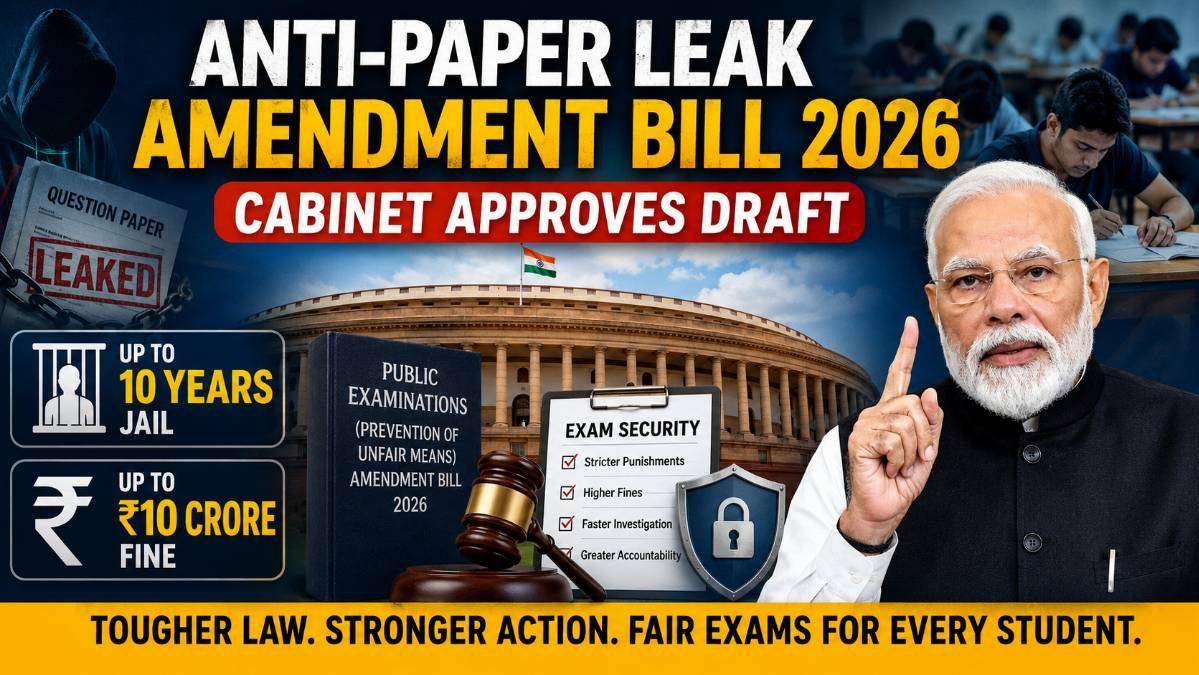
The Union Government has taken another major step to strengthen the legal framework against examination paper leaks and organized cheating in public examinations.
The Union Cabinet has approved the draft Public Examinations (Prevention of Unfair Means) Amendment Bill, 2026, which proposes stricter punishments, higher financial penalties, and faster judicial proceedings for those involved in examination fraud.
The proposed amendment is intended to reinforce the existing Public Examinations (Prevention of Unfair Means) Act, 2024, which came into force on June 21, 2024.
Background: The Public Examinations Act, 2024
The Public Examinations (Prevention of Unfair Means) Act, 2024 was enacted by Parliament to protect the integrity of public examinations conducted by the Central Government and its agencies.
The law aims to prevent organized cheating, question paper leaks, impersonation, unauthorized access to examination systems, and other unfair practices that compromise the credibility of competitive examinations.
The Act applies to major public examinations conducted by organizations such as:
- Union Public Service Commission (UPSC)
- Staff Selection Commission (SSC)
- National Testing Agency (NTA)
- Railway Recruitment Boards (RRBs)
- Banking recruitment agencies
- Any other public examination notified by the Central Government
Union Cabinet Approves Draft Amendment Bill
According to official government decisions and reports, the Union Cabinet has approved a draft amendment to further strengthen the existing law. The proposed amendment is expected to be introduced in Parliament for discussion and approval.
The Cabinet’s decision reflects the government’s objective of enhancing transparency, accountability, and fairness in public examinations across the country.
Key Proposed Changes
Stronger Punishments
The proposed amendment recommends significantly stricter penalties for individuals, organized groups, institutions, examination centres, and service providers found guilty of involvement in paper leaks or organized examination fraud.
- Maximum imprisonment of up to 10 years.
- Financial penalties of up to ₹10 crore in serious cases.
- Stronger accountability for examination agencies, institutions, and outsourced service providers.
These enhanced penalties are intended to serve as a stronger deterrent against organized examination malpractice.
READ THIS: NEET UG 2027 Goes Computer-Based Government Confirms CBT Exam Format for Medical Aspirants
Faster Investigation and Trial
The amendment also proposes mechanisms for quicker investigation and speedy trial of paper leak cases. The objective is to ensure that offences are investigated without unnecessary delays and that legal proceedings conclude more efficiently.
The government has indicated that dedicated judicial mechanisms may be used to accelerate the disposal of such cases.
Greater Accountability of Institutions
The draft amendment expands responsibility beyond individual offenders. Institutions, examination centres, technology service providers, and organizations that facilitate or knowingly participate in examination fraud may also face stringent legal consequences under the proposed framework.
Current Legal Status
As of now, the Union Cabinet has approved the draft amendment. The proposal must still complete the legislative process before becoming law. It will need to be introduced and passed by both Houses of Parliament and subsequently receive the assent of the President of India before the amended provisions come into force.
READ THIS: NSA Ajit Doval to Receive Lokmanya Tilak National Award 2026
Objective of the Amendment
The proposed amendment seeks to protect the interests of millions of students and job aspirants who appear for competitive examinations every year. By prescribing tougher punishments and strengthening enforcement, the government aims to improve the credibility, transparency, and fairness of India’s public examination system.
The amendment also seeks to discourage organized criminal networks involved in paper leaks while reinforcing public confidence in recruitment and entrance examinations.
Conclusion
The Union Cabinet’s approval of the draft Public Examinations (Prevention of Unfair Means) Amendment Bill, 2026 represents an important step toward strengthening India’s legal framework against examination malpractice.
The proposal introduces stricter punishments, higher financial penalties, and provisions for faster investigation and trial of serious offences. However, the amendment is currently at the proposal stage.
It will become legally enforceable only after it is passed by Parliament and receives Presidential assent. Until then, the Public Examinations (Prevention of Unfair Means) Act, 2024 remains the law governing unfair practices in public examinations.
About The Author